
November 4, 2026 | Pivotal Point Research
Markets delivered an extraordinary reaction to the election results overnight. The initial response was a sharp sell-off across equities, followed by an equally dramatic reversal that caught many participants off guard.
The Nasdaq 100 (QQQ) declined approximately 3% during the initial reaction. Over the following hours, however, it rallied approximately 3.5%. In a matter of hours, market sentiment shifted from extreme bearishness to aggressive buying.
This is precisely why we focus on price action rather than attempting to predict how markets will interpret political events.
The important question now is not why the market reversed. It is whether the reversal has enough strength to change the existing market structure.
Our answer, for now, is to remain patient.
Several markets have recovered important pivotal levels, including SPY, gold, silver, Bitcoin, and small-cap stocks. But QQQ remains below a critical resistance area, and we are not yet prepared to declare that its intermediate-term downtrend has ended.
What matters now?
For the Nasdaq, the immediate test is $703–$704.
For the S&P 500, it is $764.
For the Russell 2000, it is $2,888–$2,900.
For gold, it is $4,100.
For silver, it is $55.45.
These are the levels that will help determine whether the overnight rally develops into a more durable change in market structure.
Here is what we are watching.
1. Nasdaq 100 (QQQ): A Powerful Reversal, but $703–$704 Is the Test
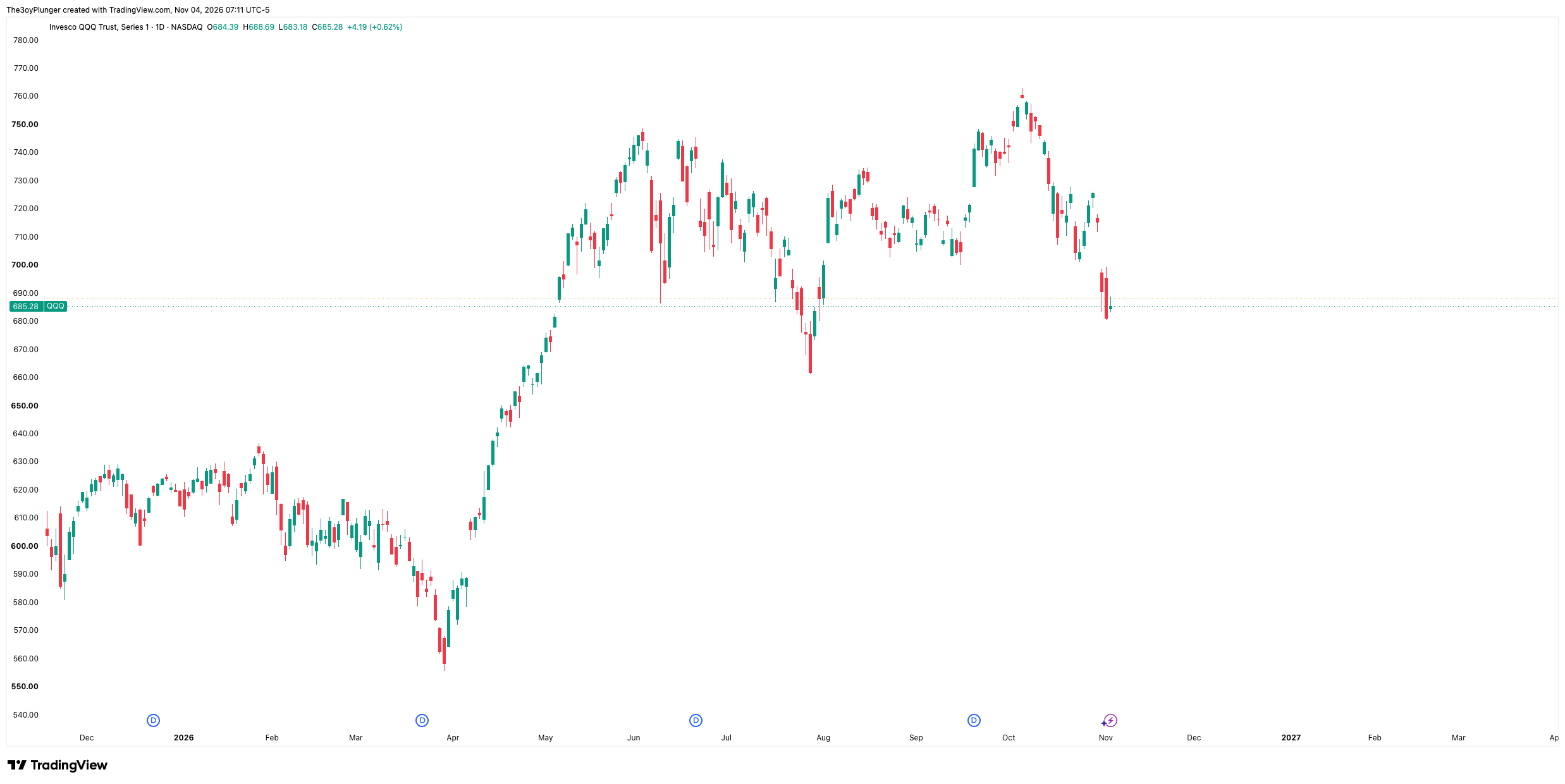
The Nasdaq has been consolidating since June, with the October 6–7 high marking the beginning of a more pronounced intermediate-term decline.
Before the election, we identified a balance area with support around $680–$683 and resistance extending toward $698–$702. We anticipated the possibility of a short-covering rally, but the market failed to produce that move during Tuesday's regular session.
The election reaction changed the picture dramatically.
As results began coming in, QQQ initially sold off approximately 3%. The decline brought the market close to its larger situational-awareness reference. QQQ reached an overnight low around $669, where responsive buyers appeared.
From approximately 11 PM through the early morning, the market rallied around 3.5%.
This is an extraordinary change in sentiment over a very short period.
Has the downtrend ended?
Not yet.
It is important to distinguish between the broader uptrend that began in 2022 and the more recent intermediate-term decline that developed after the October high.
The broader trend remains intact. However, on the one-hour chart, QQQ is still working through the decline that began in early October.
The next important level is $703–$704.
We are approximately 1.3% below this area in the early-morning commentary. This is where the market must prove whether the overnight rally represents a genuine change in character or simply another short-covering move within the existing consolidation.
Our scenarios
Bullish scenario: A convincing break above $703–$704 would improve the technical picture and could signal that the intermediate-term decline is ending. A sustained move higher would bring the previous highs back into focus.
Bearish scenario: If QQQ fails around $703–$704 and reverses, the market could give back a meaningful portion of the overnight rally.
We are also retaining $669 as an important downside reference. Buyers appeared around this level during the overnight sell-off, making it an area worth monitoring.
The market has given us an important rebound. It has not yet given us confirmation of a trend reversal.
2. S&P 500 (SPY): Stronger Structure, With $764 as the Immediate Test
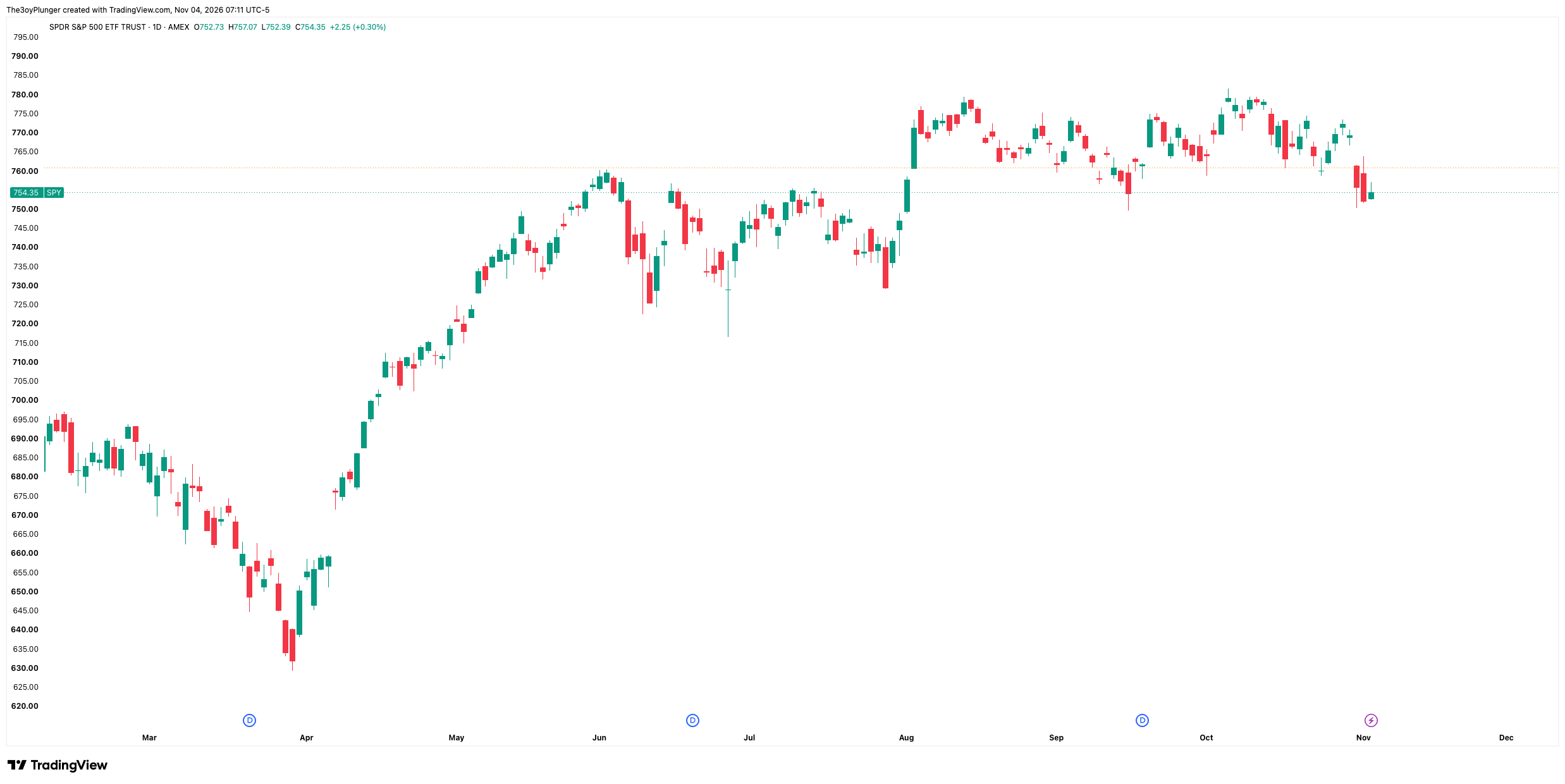
The SPY structure looks somewhat different from QQQ.
Unlike the Nasdaq, which has been trading within one large consolidation area, the S&P 500 has developed two more clearly defined balance areas. The market broke out of the earlier area in August and has generally maintained that structure.
During the initial election reaction, SPY briefly broke below an important support area. It subsequently reversed sharply, recovering the lost ground.
The immediate reference is now $764.
This level is important because it corresponds with a previous pivotal point and the November 2 high.
We want to see how the regular trading session responds when the market reaches this area. Overnight buying can be powerful, but it is important to see whether buyers remain committed once the broader market opens.
What comes next?
If SPY breaks convincingly above $764, the next references are:
- $773–$775: The next upside area.
- $781: The previous high.
However, we should not assume that the overnight rally will continue uninterrupted.
After a sharp move higher, the market may encounter sellers around previous resistance. A failure around $764 would raise the possibility that the rally is losing momentum.
For now, the larger uptrend remains intact. We are watching $764 to determine whether the market can continue higher.
3. Russell 2000: Small Caps Attempt a Trend Reversal
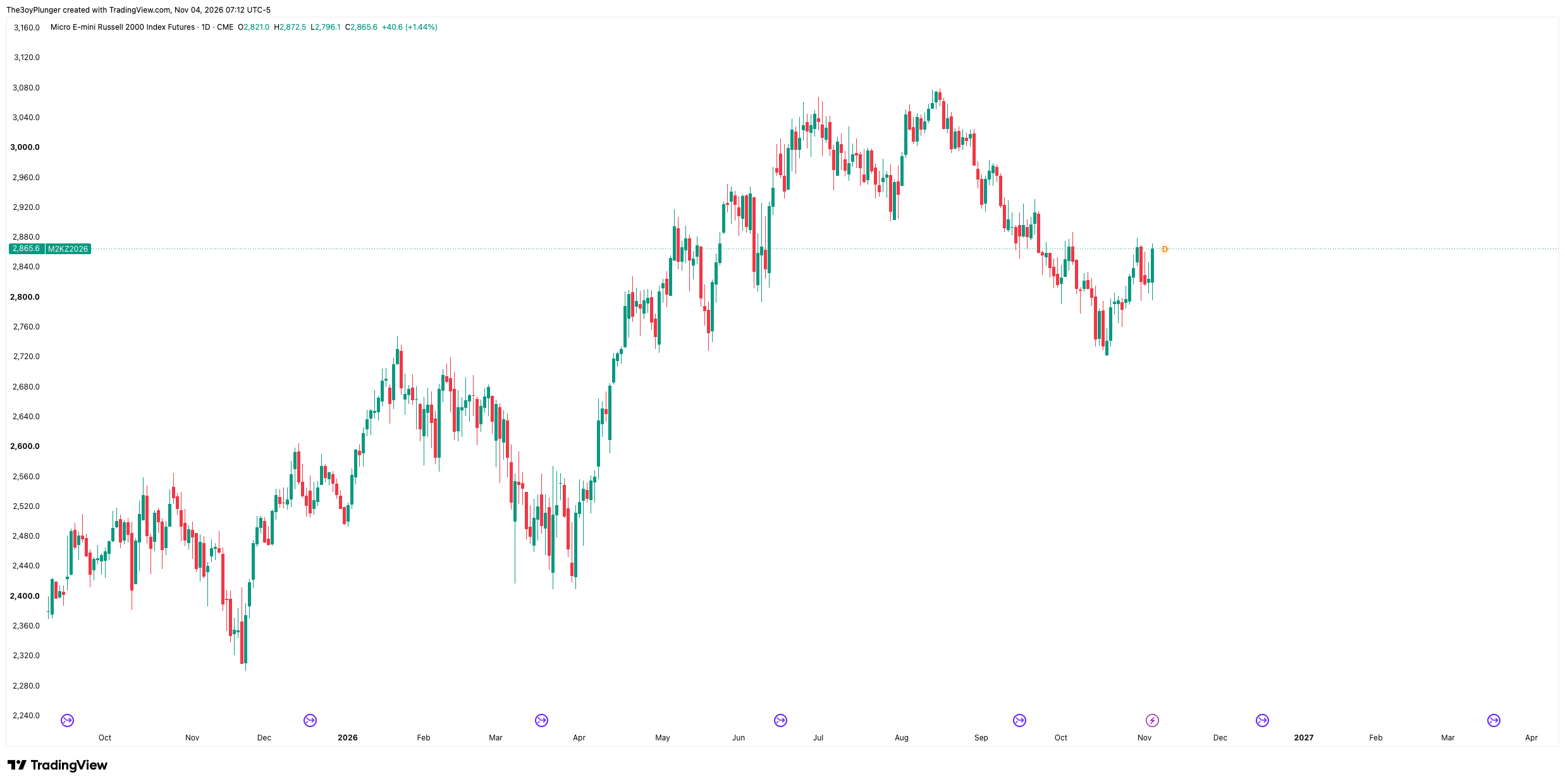
Small-cap stocks have been under pressure since their August 17 high, experiencing a correction of approximately 11–11.5%.
We had previously identified the 2,727 area as an important pivotal point, based on earlier lows established in April and May.
The market approached this area and subsequently recovered.
The 2,800 level was another important reference within the balance area we had identified. The Russell 2000 held that area and rallied approximately 2.5%.
This is an encouraging development.
The market is now attempting to reverse the intermediate-term downtrend.
What confirms the reversal?
We want to see a convincing move above 2,888–2,900.
The 2,900 level is particularly important because it represents a previous pivotal point.
A sustained move above this area would provide stronger evidence that the small-cap correction is ending.
Until then, we characterize the move as an attempted reversal rather than a confirmed change in trend.
4. Gold: Break Above $3,977 Opens the Door to a Larger Recovery
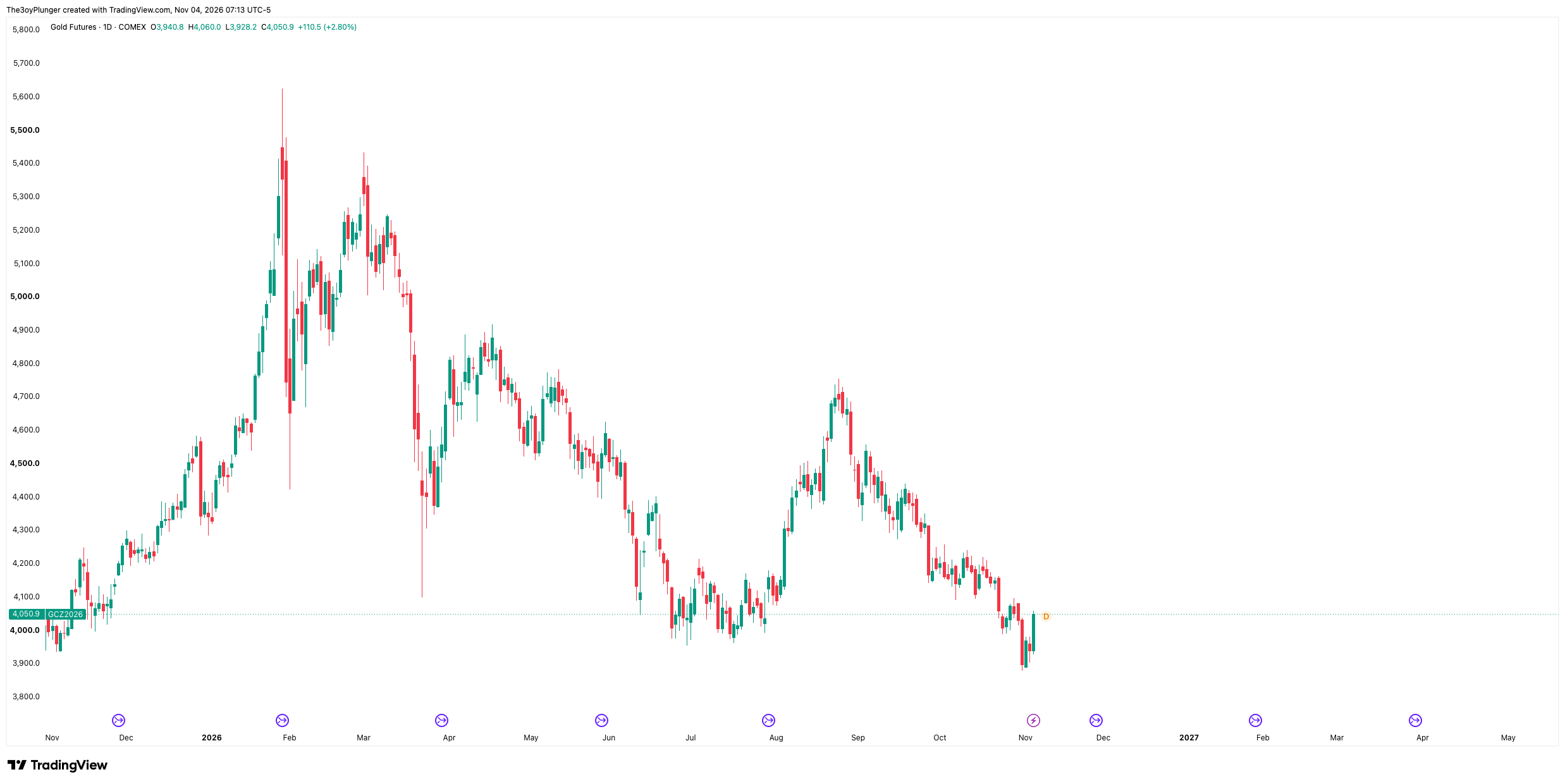
Gold produced one of the more constructive moves overnight.
In our previous commentary, we identified $3,977 as an important pivotal point. The market initially struggled around that area, but after breaking above it, gold rallied toward approximately $4,050.
This is an important technical development.
Gold has moved back into its previous trading range and is attempting to recover the structure lost during the recent correction.
The next level we are watching is $4,100.
Why $4,100?
Our monthly market profile identifies this area as an incomplete balance zone where the market could encounter resistance.
Two possible outcomes
Bullish scenario: A sustained move above $4,100 would strengthen the case that gold is reversing its recent downtrend and attempting to recover the previous monthly range.
Consolidation scenario: If gold fails to clear $4,100, it could establish a new balance area between approximately $3,879 and $4,100.
For now, the recovery above $3,977 is encouraging. The next test is whether buyers can establish value above $4,100.
5. Silver: A Strong Bounce, but $55.45 Is the Important Resistance
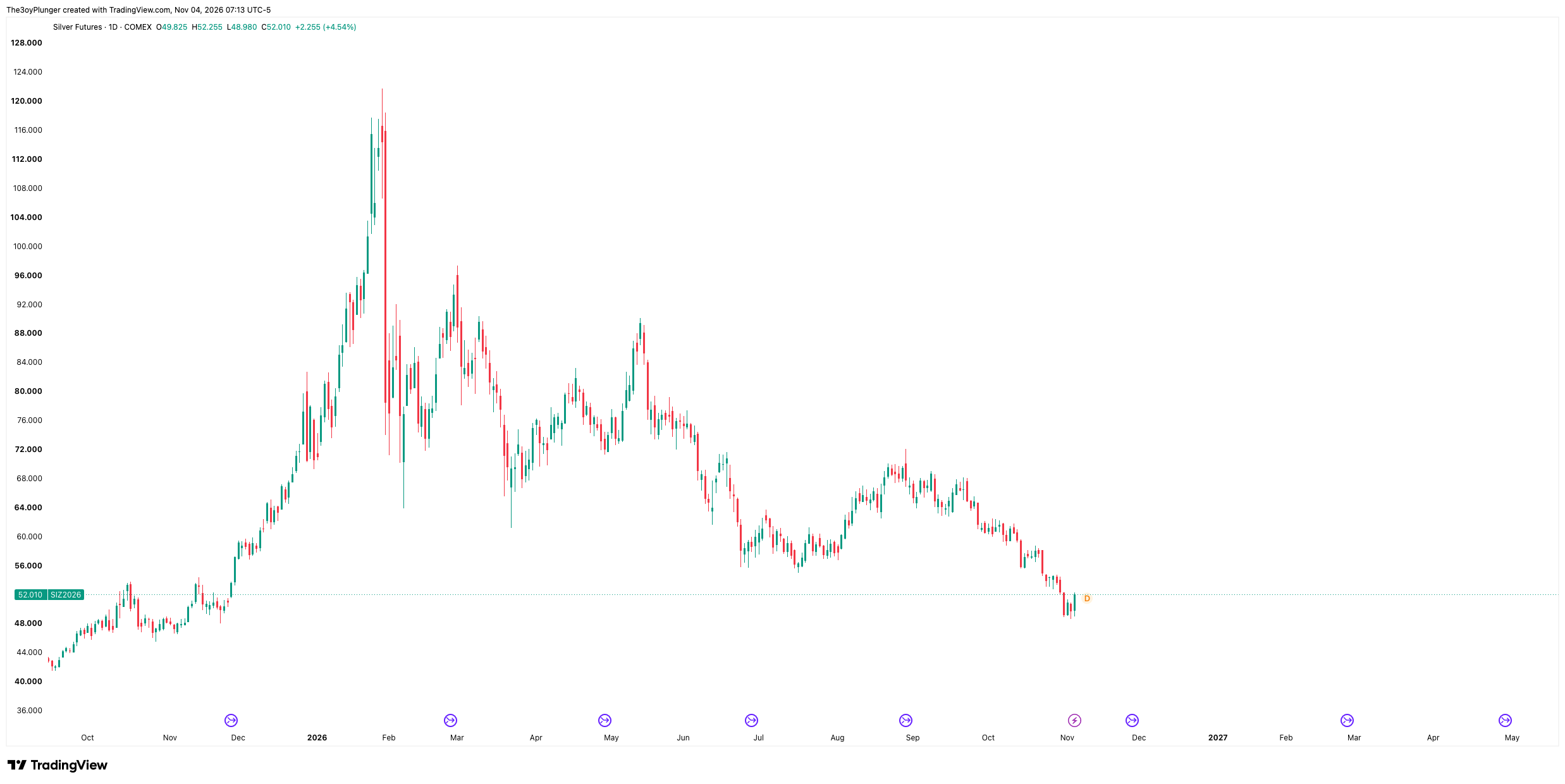
Silver rallied approximately 4.5% overnight.
The market had been in a well-defined downtrend after losing the important $55 area. It subsequently consolidated for several sessions and found support around $48.
The latest rally has taken silver out of that short-term consolidation.
That is a constructive development, but we need to distinguish between a short-covering rally and a genuine reversal.
The next important resistance is approximately $55.45, corresponding to the previous support area.
A sustained move above $55.45 would provide stronger evidence that buyers are regaining control.
If silver fails around this level, the market could simply be experiencing a temporary bounce before another move lower. The previously identified $45 area therefore remains relevant.
For now, this is a positive development for silver bulls, but the trend has not yet been confirmed as reversed.
6. Treasury Bonds (TLT): Limited Reaction to the Election
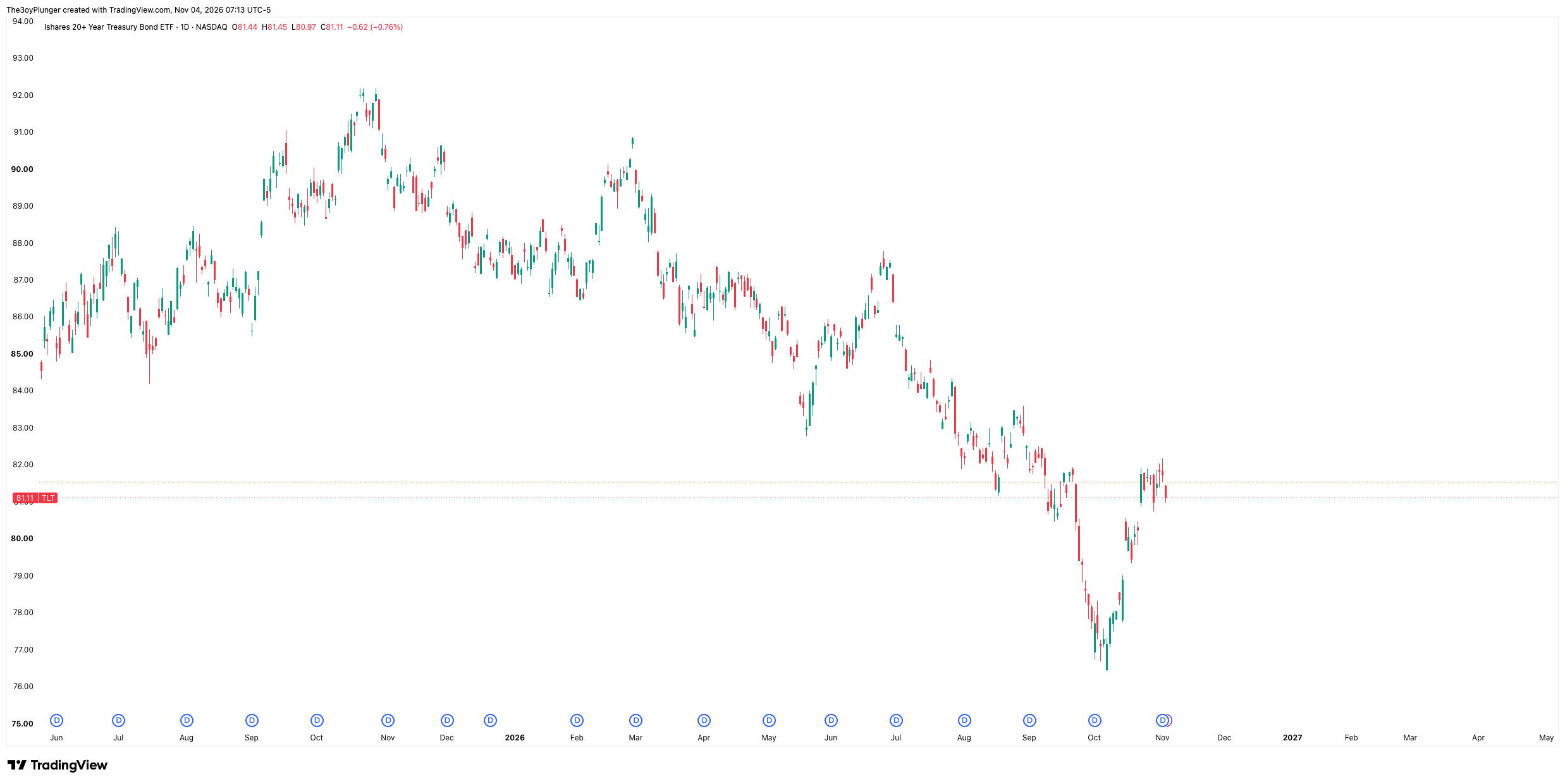
Treasury bonds showed a relatively muted response to the election.
Despite the magnitude of the political event and the volatility across other asset classes, TLT was up only approximately 0.29% in the early-morning commentary.
This suggests that the bond market is not making a particularly strong directional statement.
Our key reference remains $82.20.
We want to see whether TLT can establish value above this level or whether it continues to develop lower value areas.
The broader question is whether Treasury bonds will begin attracting stronger demand or remain in their existing consolidation.
For now, we are waiting for the market to resolve the area around $82.20.
7. Bitcoin: $75,000 Holds, Followed by a Strong Recovery
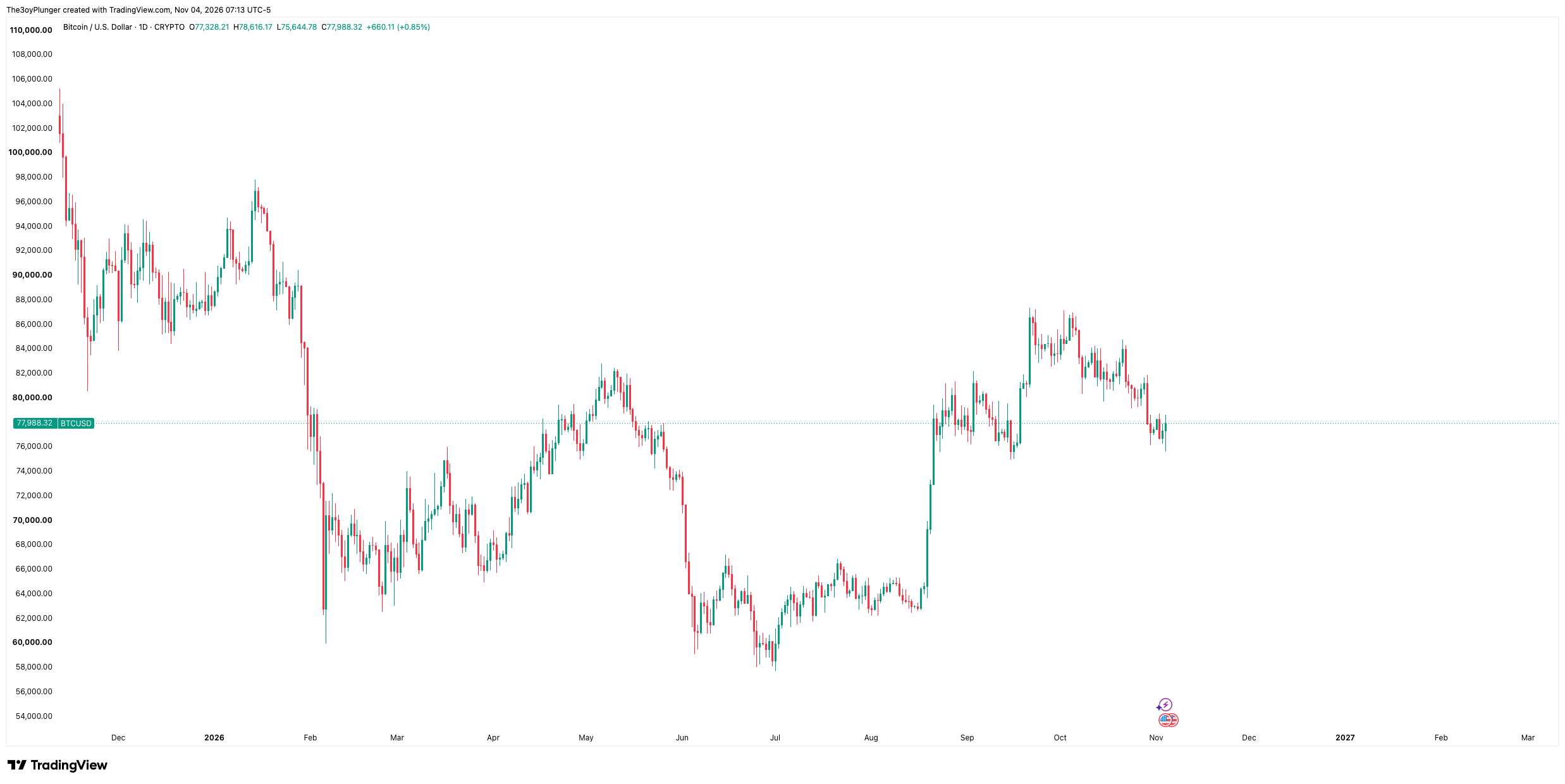
Bitcoin also experienced the overnight volatility.
We had repeatedly identified $75,000 as an important pivotal point. During the initial election reaction, Bitcoin approached that level, trading as low as approximately $75,795.
Buyers subsequently stepped in.
From the overnight low to the early-morning price, Bitcoin recovered approximately 4%, although the gain relative to the previous session's close was closer to 1%.
The important observation is that the $75,000 area held.
This keeps the broader technical picture constructive, although Bitcoin remains subject to the same uncertainty as the other markets.
We will continue monitoring whether it can sustain its position above this pivotal area.
8. The Bigger Picture: Corrections Are Not Automatically Bear Markets
One of the most important lessons from this episode is how quickly market sentiment can change.
In a matter of hours, the Nasdaq moved from a sharp decline to an aggressive rally. Similar reversals appeared across several other asset classes.
It is tempting to interpret every sharp decline as the beginning of a bear market. It is equally tempting to interpret every powerful rally as the beginning of a new bull market.
Neither conclusion is justified without confirmation.
Consider the historical behavior of the Nasdaq during the dot-com bear market. Even after substantial declines, the market experienced powerful countertrend rallies, including advances of 15%, 21%, 28%, and considerably more at certain points.
Bear markets are not characterized by uninterrupted declines. They contain powerful rallies that can make the underlying trend difficult to recognize.
That is why we focus on the larger structure.
The current correction has been meaningful, but it is not yet comparable to the prolonged and severe declines seen during historical bear markets.
That does not mean a larger decline cannot develop. It means we should not assume one before the market provides evidence.
Key Levels to Watch
| Market | Important upside level | Important downside reference |
|---|---|---|
| QQQ | $703–$704 | $669 |
| SPY | $764; then $773–$775 and $781 | Previous balance support |
| Russell 2000 | 2,888–2,900 | 2,800; then 2,727 |
| Gold | $4,100 | $3,977; then $3,879 |
| Silver | $55.45 | $48; then $45 |
| TLT | $82.20 | Watch for developing lower value |
| Bitcoin | Sustained strength above $75,000 | $75,000 |
These are market reference levels and conditional scenarios, not guaranteed price targets.
Final Thoughts: Let the Market Do the Talking
The election produced a dramatic overnight reaction, but the most valuable information came from the market itself.
We saw selling, responsive buying, short covering, and a rapid change in sentiment. Several important pivotal levels held, and multiple markets are now attempting to reverse their recent declines.
But an attempted reversal is not the same as a confirmed reversal.
Our approach remains the same: identify the balance areas, monitor the pivotal points, and wait for price acceptance or rejection to reveal the next direction.
We do not need to predict the news. We need to understand how the market responds to it.
Patience, discipline, and respect for price action remain our guiding principles.
⚖️ Required Footnote Disclaimers
- Regulatory Compliance Notice: Pivotal Point Research is an independent publisher of general-interest financial information and technical market commentary. We are not registered investment advisors, financial planners, or broker-dealers with the SEC or any state regulatory body. This commentary does not constitute personalized investment advice, financial planning, or an endorsement or solicitation to buy or sell securities. All content is prepared strictly for educational, informational, and general research purposes under the publisher's exemption.
- Risk Disclosure: Trading equities, commodities, currencies, and futures involves a high degree of risk, including the potential loss of principal capital far exceeding initial margin requirements. Past performance, asset correlations, and breakout models do not guarantee future results. Subscribers are entirely responsible for their own independent financial and risk management decisions.